

How building surfaces affect commercial sign installation comes down to what the sign is attaching to, what sits behind that surface, and how the sign’s weight and electrical components must be supported. Brick, concrete, stucco, EIFS, metal panels, and wood can all require different sign mounting methods, hardware, access plans, and installation details.
At Vintage Sign & Light, we review the actual building before treating installation as a standard process. A mounting method that works on one storefront may not work on the building next door, even when both businesses use similar channel letters.
Quick Summary
- The visible façade is only part of the mounting decision. We also need to understand the structure behind it.
- Brick, concrete, stucco, EIFS, metal panels, and wood can require different attachment methods and installation planning.
- Channel letters are especially affected because mounting, wiring, alignment, and wall penetrations must work together.
- A site survey before fabrication can identify surface, access, electrical, and structural conditions that may change the installation plan.
Written by the Vintage Sign & Light Team
We design, manufacture, install, repair, and maintain commercial signs throughout Northwest Florida and the Emerald Coast. Our work includes channel letters, monument signs, pylon signs, and Watchfire digital displays, along with site surveys, engineering coordination, permitting, and installation support. Vintage Sign & Light is a veteran-owned, family-operated, state-certified electrical sign contractor with more than 50 years of signage expertise.

Why Does the Building Surface Matter for Sign Installation?
The building surface affects where we can attach the sign, what mounting hardware may be appropriate, how wiring can pass through the façade, and whether additional structural review is needed.
A sign does not simply hang from whatever material is visible from the parking lot. The finished wall may cover concrete block, steel framing, wood framing, sheathing, insulation, or another structural system. That distinction matters.
For example, two storefronts may both appear to have stucco walls. One may have stucco over masonry, while another may use a lightweight exterior wall assembly. The installation plan cannot assume that both walls provide the same attachment conditions.
Model building-code provisions also recognize the importance of the attachment itself. ICC Appendix H calls for sign construction documents, where required, to include details such as loads, stresses, and anchors, and it addresses secure attachment to materials such as masonry, concrete, and steel. This is why we consider the wall and structure during planning rather than waiting until installation day.
How Do Common Building Surfaces Change Sign Mounting?
Each façade creates a different set of mounting considerations. The exact solution depends on the sign, building construction, approved plans, and field conditions, but several patterns are useful to understand.
| Building Surface | What We Need to Evaluate | Possible Installation Concern | Why It Matters |
| Brick or masonry | Brick condition, mortar, wall structure, anchor locations | Brittle or aging material, uneven surface | Attachment points must support the sign without assuming the face material alone is suitable |
| Concrete | Thickness, reinforcing conditions, drilling locations | Dense material and concealed conditions | Mounting may require specific anchors and drilling methods |
| Stucco | What is behind the finish | Finish can hide different wall assemblies | The visible stucco alone does not tell us where structural attachment should occur |
| EIFS | Foam insulation and underlying substrate | Exterior finish may not provide structural support | Mounting often needs to reach suitable supporting construction behind the system |
| Metal panels | Panel profile, seams, framing behind panels | Thin panels may flex or provide limited attachment support | Fastener locations may need to correspond with structural framing |
| Wood | Wood type, framing, condition, exposure | Deterioration or unsuitable attachment points | Existing material condition can change the installation approach |
| Mixed façades | Transitions between several materials | Different depths and attachment conditions | A single sign may cross more than one wall assembly |
The surface type does not automatically determine the hardware. We need to understand the complete wall condition first.
How Does Brick or Masonry Affect Commercial Sign Installation?
Brick and masonry can support commercial signs well, but the mounting plan still depends on the wall type and condition. Older brick, masonry veneer, concrete block, previous holes, and damaged areas can all affect drilling and anchor placement.
For channel letters, direct mounting may require multiple attachment and electrical penetration points. Raceway-mounted letters can reduce or concentrate those attachment points, but the right approach still depends on the building, sign design, electrical plan, and approved mounting details. We review these factors during commercial sign installation planning.
Concrete also requires careful planning. Wall thickness, reinforcement, existing penetrations, sign weight, and the type of concrete can affect the attachment method.
For larger or more exposed signs, structural review may also be needed. Our sign engineering services can account for sign dimensions, weight, mounting conditions, building height, and wind exposure.
What Changes When a Building Has Stucco?
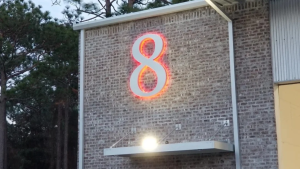
With stucco, the most important question is often: What is behind it? Stucco is the visible finish, but the underlying wall construction determines how the sign can be supported. A stucco surface may cover masonry, framed construction, or another wall system.
That means we do not want to plan sign mounting from exterior photos alone when the underlying construction is uncertain. Penetrations also need to be planned carefully because the finished wall must remain properly detailed around mounting and electrical locations.
For illuminated channel letters, wiring adds another consideration. The letter locations, electrical pass-throughs, power supplies, and mounting layout all need to work with the building conditions.

Is EIFS the Same as Stucco for Sign Mounting?
No. EIFS and traditional stucco can look similar from the outside, but they are not necessarily the same wall system.
EIFS typically incorporates an insulation layer as part of the exterior assembly. Because that outer layer is not automatically a structural mounting surface, the installation may need attachment to suitable construction behind it.
The depth of the wall assembly also matters. Longer attachment paths or specialized mounting details may be required depending on the sign and building.
This is one reason a pre-installation survey is valuable. We can document visible wall conditions, measurements, existing penetrations, access, and other details before the sign reaches manufacturing.
Our commercial sign site surveys may include building dimensions, mounting surfaces, wall or fascia construction, electrical access, sign height, equipment access, and other installation conditions.
How Do Metal Panels Affect Channel Letter Installation?
Metal-panel buildings require us to consider both the panel itself and the structure behind it. A panel may appear solid while providing limited structural attachment on its own. Panel seams, corrugations, ribs, insulation, air spaces, and framing locations can all affect the mounting layout. The surface may also be uneven.
For channel letters, this can affect:
- Letter alignment
- Raceway placement
- Stand-off conditions
- Fastener locations
- Electrical penetrations
- Sealing details
- Access behind the façade
For example, placing a raceway across a ribbed metal façade can create different contact points than mounting it to a flat wall. We need the mounting system to account for those changes rather than forcing a flat installation detail onto an uneven surface.

What About Wood or Framed Exterior Walls?
Wood and framed walls can support commercial signs when the attachment plan matches the construction and condition of the building.
We need to identify suitable framing or backing instead of assuming exterior siding or sheathing provides the necessary support.
Age and exposure can also affect the wall. Northwest Florida properties can experience strong sun, moisture, storms, and coastal conditions, so visible deterioration deserves attention before new signage goes up.
If an existing sign has been removed, the old mounting locations should also be reviewed. Previous holes do not automatically mean those locations should be reused.
How Does the Surface Affect Channel Letters Specifically?
Building surfaces have the greatest direct effect on VSL products that attach to a façade, especially channel letters. We generally consider two broad channel-letter mounting configurations:
Direct-Mounted Channel Letters
With direct mounting, individual letters attach to the building. This can create a clean appearance, but it may require more individual attachment points and electrical penetrations. The wall construction therefore plays a major role in the mounting pattern.
Raceway-Mounted Channel Letters
With a raceway, the letters attach to a fabricated structure that then mounts to the building. This can concentrate mounting and electrical work into fewer areas, depending on the design. A raceway can also be useful when the façade makes individual mounting more complex. Neither approach is automatically better.
We look at the building surface, available backing, electrical access, sign criteria, permitted design, appearance, and future service needs before deciding what makes sense for the project.
Do Monument and Pylon Signs Depend on Building Surfaces?
Not in the same way. Monument signs and pylon signs are normally supported from the ground rather than attached directly to a building façade. Their installation depends more heavily on foundations, structural supports, soil or site conditions, underground utilities, electrical service, and access.
However, the same principle applies: installation should follow the actual site conditions rather than a generic mounting assumption.
Watchfire digital displays may also become part of a monument or pylon structure. In that case, we need to coordinate the display with the supporting sign structure and electrical system. That is why surface conditions are only one part of the larger installation picture.
What Should Be Checked Before the Sign Is Manufactured?
We prefer to identify mounting conditions before fabrication rather than discovering them after the completed sign arrives.
Depending on the project, we may review:
- The exact wall material and wall assembly.
We document what can be seen and identify where more information may be required. - The proposed sign location.
Window locations, architectural features, façade changes, and available sign area can affect placement. - Existing mounting points.
Old penetrations or hardware may provide useful information, but we do not assume they can support the new sign. - Electrical access.
Illuminated channel letters and digital sign systems need an electrical plan that works with the property. - Equipment access.
The crew may need a bucket truck, lift, crane, or other equipment to reach the installation area. - Parking and traffic conditions.
The work area needs enough space for equipment and a controlled installation zone. - Landlord and permit requirements.
Sign criteria can affect placement, size, mounting style, and other details before production starts.
OSHA construction rules include specific requirements for aerial lifts, which are commonly used when crews need elevated access to building-mounted signs. This is another reason access planning matters before installation day.
Can the Building Surface Change Installation Cost or Timing?
Yes. Surface and structural conditions can change the amount of labor, equipment, hardware, electrical work, engineering, or preparation involved.
A straightforward mounting area with known backing and easy lift access may require a different installation scope than a tall storefront with an unusual façade and limited equipment access.
Conditions that can affect pricing include:
- Mounting height
- Building material
- Structural requirements
- Installation equipment
- Electrical scope
- Existing sign removal
- Access restrictions
- Permit requirements
- Engineering needs
- Surface repairs or unexpected conditions
We do not recommend estimating installation from sign dimensions alone. The same channel letter set could involve different installation requirements on two different buildings. That is why our pricing process starts with the property, sign, and installation conditions rather than a generic installation rate.
What Are Common Building-Surface Mistakes to Avoid?
The biggest mistake is treating the exterior finish as though it tells us everything about the structure. Other problems can start when a project:
- Selects mounting hardware before confirming the wall assembly
- Assumes existing holes can be reused
- Ignores framing or structural attachment locations
- Designs channel letters before confirming electrical access
- Fabricates a sign from architectural drawings without verifying current field conditions
- Fails to account for façade depth or uneven panels
- Leaves equipment access until installation day
- Assumes one mounting detail will work across every location in a multi-site rollout
For a national sign company or multi-location brand, these differences are especially important. Two locations may use the same logo and sign dimensions but have completely different façades. A repeatable sign program still needs location-specific field verification.
How We Plan Commercial Sign Installation in Northwest Florida
We approach installation as part of the full sign process, not as a separate task left until the end. Our process generally includes reviewing site conditions, coordinating the required scope, preparing the needed equipment, completing the approved mounting and electrical work, and checking the finished installation.
Northwest Florida also makes site-specific planning particularly important because buildings vary widely across retail centers, freestanding commercial properties, coastal developments, offices, restaurants, medical properties, and multi-tenant locations.
Florida maintains its own current building-code framework, including the 8th Edition (2023) Florida Building Code and subsequent supplements. The exact requirements that apply to a sign project depend on the property, jurisdiction, sign type, and scope.
We therefore coordinate applicable structural, electrical, permitting, and property requirements according to the project instead of treating every installation the same way.
FAQs
Can channel letters be installed on any building surface?
Channel letters can work with many commercial building types, but the mounting method may need to change. We first consider the wall assembly, attachment points, sign weight, electrical access, landlord requirements, and approved design.
Is brick easier for sign mounting than stucco?
Not automatically. Brick, masonry, and stucco can each have different underlying construction and surface conditions, so we need to evaluate the actual wall rather than rank one material as universally easier.
Do I need a site survey before installing a commercial sign?
A site survey is useful when field conditions affect measurements, mounting, access, electrical service, visibility, or installation planning. It can help identify conflicts before design, engineering, manufacturing, or installation moves too far forward.
Can an installer use the mounting holes from my old sign?
Sometimes existing conditions may be usable, but they should not be assumed suitable for a new sign. The new sign may have different dimensions, loads, electrical needs, mounting patterns, or engineering requirements.
Expert Tip
Before approving the final sign layout, take one straight-on photo of the entire façade and several close-up photos of the proposed mounting area. Include corners, seams, wall transitions, existing penetrations, and nearby electrical equipment. Those views can reveal conditions that a cropped storefront photo may leave out.
Plan the Mounting Before the Sign Reaches the Wall
The building surface should influence a commercial sign project long before installation begins. We need to understand what the sign will attach to, what supports exist behind the finish, how electrical components will reach the sign, and what equipment can reach the work area.
For channel letters in particular, early field verification can help us align the design, mounting pattern, electrical plan, engineering, and installation approach with the actual property.
If you are planning a commercial sign in Northwest Florida, send Vintage Sign & Light your property address, current building photos, sign information, and project requirements. We can review the site and provide budget pricing based on the actual installation scope.